

Table of Contents
Dental Bridge vs Implant: Understanding Your Tooth Replacement Options
When considering dental bridges vs implant options for replacing a missing tooth, you are choosing between two proven restorative solutions, each with unique advantages. According to the Canadian Dental Association, both approaches can restore function and appearance, though they differ in how they work, how long they last, and the treatment process involved. At The Grove Dentistry, we often discuss that a dental bridge fills the gap by anchoring to neighboring teeth, while a dental implant replaces both the root and crown for independent support. The dental implant success rate is notably high, and the typical dental bridge lifespan can reach many years with proper care. Let’s explore each option in more depth so you can make an informed choice. Results may vary for each individual.
1. Longevity Compared
When considering dental bridge vs implant solutions, the expected lifespan of each restoration is often a deciding factor. At The Grove Dentistry, we believe that understanding how long these treatments typically last helps our patients feel confident in their choices. Both options restore function and appearance, but their durability over time differs significantly.
The longevity of dental implants in Port Coquitlam is one of their most compelling advantages. According to our clinical experience at The Grove Dentistry, the documented dental implant success rate exceeds 95% over a ten-year period. With consistent oral hygiene and regular professional check-ups at our clinic, a titanium implant can often last 20 years or more and has the potential to remain functional for a lifetime. This durability is rooted in osseointegration, the biological process where the post fuses directly with your jawbone, creating a stable, long-term foundation.
In contrast, the typical dental bridge lifespan ranges from 5 to 15 years, as noted on our service pages at The Grove Dentistry. While a bridge is a reliable and effective restoration, it generally does not last as long as an implant because the supporting natural teeth remain susceptible to decay or structural fatigue over time. Even with excellent care, a bridge will likely require replacement during a patient’s life.
Of course, the actual longevity of any dental restoration depends on your personal oral hygiene routine, your commitment to regular dental visits, and your individual health circumstances. Ultimately, implants offer a durability profile that simply outpaces traditional bridges, making them a compelling option for patients seeking a permanent solution.
2. Bone Health Impact
Beyond the basic differences, one of the most important factors when weighing a dental bridge vs implant is your bone health. Dental implants require a healthy jawbone because the titanium post must fuse with the bone through a process called osseointegration. The dental implant success rate is closely tied to adequate bone density, and without sufficient volume the implant cannot achieve the stability needed to function like a natural tooth.
During your dental implant procedure in Port Coquitlam, our team will first evaluate your jawbone density using X-rays or CT scans to confirm there is enough healthy bone to support the implant. Bone loss can occur after a tooth extraction, from periodontal disease, or from long-term detention wear—all of which may reduce candidacy for implants.
Bridges, by contrast, do not rely on jawbone density. Instead they depend on strong adjacent teeth to anchor the prosthetic, which means the dental bridge lifespan is influenced by the health of those supporting teeth rather than the underlying bone.
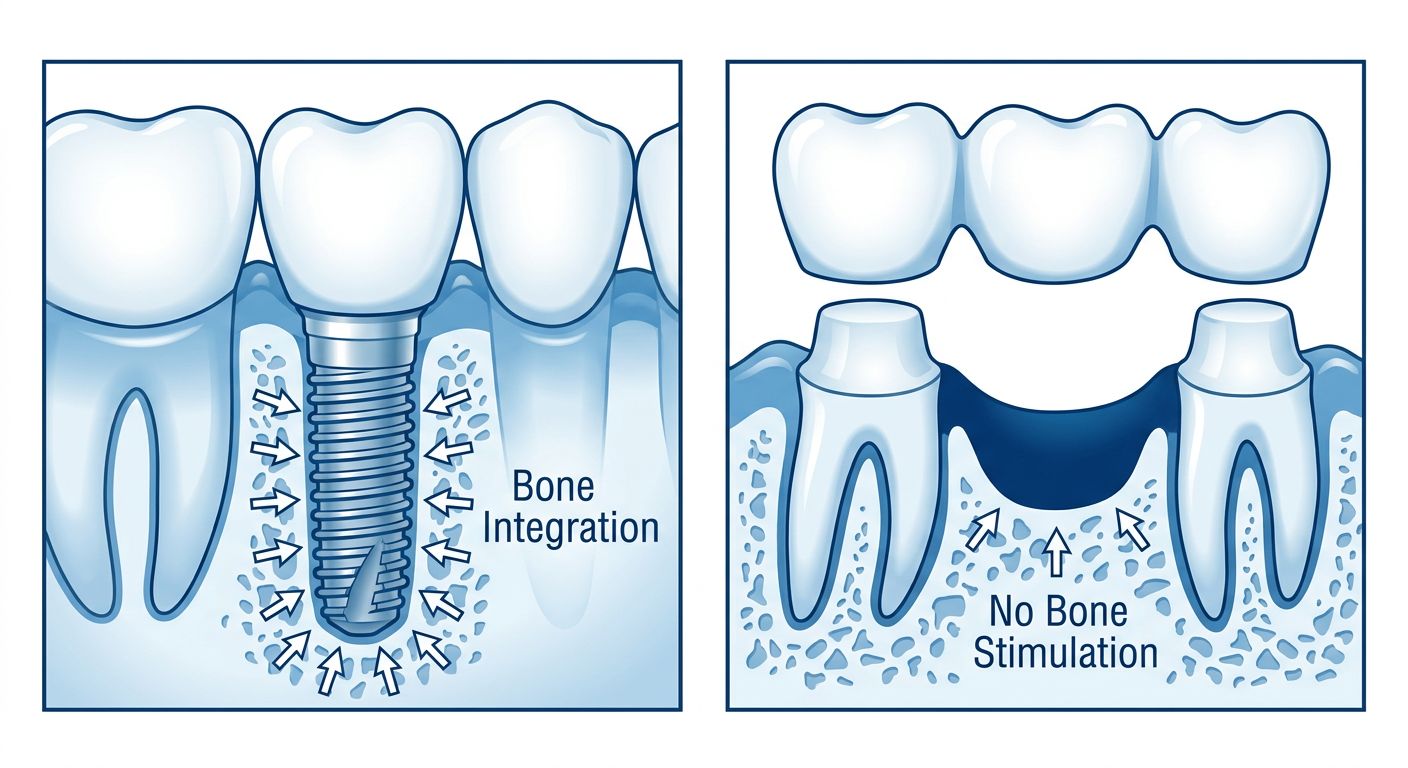
Dental implant vs bridge: bone preservation impact
If bone volume is insufficient, bone grafting may be recommended to build up the area before implant placement, though results may vary and are not guaranteed. Understanding how bone health affects treatment leads us to compare the procedures themselves.
3. Lifetime Value Analysis
Now that we understand the basic differences, let’s look at the lifetime value of each option. A dental bridge vs implant decision often comes down to long-term costs and oral health outcomes.
A typical dental bridge lifespan is 5–15 years before replacement is needed, while an implant with a crown can last 20 years or longer with proper care. According to the Canadian Dental Association, the dental implant success rate is 95–98%, and implants preserve adjacent teeth by avoiding the grinding down of healthy tooth structure that bridges require. Bridges have a lower upfront cost but may need replacement two or three times over a patient’s life, increasing total expense. Implants cost more initially but rarely need replacement beyond the crown.
Maintenance also differs: bridges demand specialized flossing under the pontic, whereas implants are cleaned like natural teeth. Factors such as oral hygiene, bone density, and professional follow-up care affect both bridge longevity and implant durability.
Understanding the long-term value helps you make an informed choice. If your bridge fails, you may wonder whether to replace dental bridge with implant – our team at Grove Dentistry offers free initial implant consultations to discuss the right path for your smile. Results may vary, so we encourage you to consult a healthcare professional for personalized advice.
In the following section, we help you decide which option fits your needs.
4. Future Replacement Flexibility
Beyond cost and lifespan, another important consideration is how easily each option can be revised or replaced. When comparing dental bridge vs implant choices, future replacement flexibility is a key difference that can affect your long-term oral health.
A dental implant sits independently in the jawbone and does not rely on the teeth around it. According to The Grove Dentistry, this independent placement means that if an implant ever needs repair or replacement, we can typically address it without touching your adjacent healthy teeth. Because a dental implant success rate typically exceeds 95%, individual implant failure is uncommon, but when it occurs, only that single unit is replaced. Additionally, since implants fuse with the bone through osseointegration, they may help maintain bone volume, which can preserve future treatment options.
In contrast, a dental bridge requires the two neighbouring teeth to be prepared and crowned. This means that if a bridge fails or needs replacement later in life, those abutment teeth may need new crowns or could be compromised, limiting your options. A dental bridge lifespan of 5 to 15 years means that several revisions might be necessary over a lifetime, each one potentially affecting the supporting teeth.
In many cases, an implant’s standalone design offers greater flexibility in future replacement scenarios. Understanding this difference helps you plan for a restoration that aligns with your long-term dental health goals.
5. Procedure and Recovery
Once you’ve decided dental implants are right for you, here’s what the process looks like at our clinic in Port Coquitlam. We guide you through each stage so you know exactly what to expect and feel confident at every step.
The first step is your free initial assessment. During this consultation, we use digital imaging and X-rays to examine your jawbone health and plan your treatment. We discuss your goals, answer all your questions, and build a personalized plan that fits your needs. Many patients mention wanting to understand the dental bridge vs implant comparison during this visit, and we are happy to walk through the differences. When considering your options, the dental implant success rate is a reassuring statistic—implants remain a clinically reliable long-term solution for missing teeth, while the typical dental bridge lifespan falls in a shorter range, which often makes implants the preferred long-term investment.
Implant placement is a single-visit procedure completed with local anesthesia. Our team places the biocompatible titanium post into the jawbone, where it begins to fuse with the bone during the osseointegration phase—a healing period that usually lasts between three and six months. If needed, we can fit a temporary crown so you maintain your smile and function during this time. Most patients describe the post-surgery sensation as mild swelling or tenderness that improves within one to two days, and recovery is generally straightforward.
After osseointegration is confirmed, we move to the restoration stage. We attach a small connecting piece called an abutment and then fabricate your custom crown to match your natural teeth in shape and color. Once the crown is securely placed, your new tooth will look, feel, and function naturally.
Recovery tips we share with our patients include:
- Stick to soft foods for the first week and avoid chewing on the implant side until cleared.
- Take any recommended over-the-counter pain relievers as directed to manage mild discomfort.
- Maintain gentle but thorough oral hygiene, brushing twice daily and flossing nightly to protect the healing area.
Our team provides detailed post-op instructions customized to your case, and we schedule follow-up visits to monitor your healing and check the fit of your final crown. While most patients heal comfortably within the expected timeline, results can vary based on individual health factors. We are here to support you through every part of your recovery.
After full healing, your new implant will feel and function like a natural tooth. Below, we break down the financial side of implant treatment.
6. Success Rates and Reliability
Once the implant is placed, you’ll naturally wonder about its long-term success. The dental implant success rate is widely documented at 95% over a 10-year period, and osseointegrated titanium implants show a 98% initial integration success rate in Canadian clinical populations. At our modern clinic in Port Coquitlam, we use advanced 3D diagnostic imaging and careful planning to support outcomes that align with these benchmarks, though individual results may vary.
Key factors that influence reliability include sufficient bone density, consistent oral hygiene, and healthy gums. We emphasize proper daily brushing and flossing to help maintain the integration between implant and jawbone. By contrast, the typical dental bridge lifespan is 5 to 10 years, whereas implants can last 15 to 25 years or longer. This notable difference underscores why many patients choose implants as a durable, long-term solution.
To see if implants are the right choice for you, schedule a free initial consultation at our Port Coquitlam clinic. Treatment outcomes are not guaranteed and depend on individual circumstances.
7. Adjacent Tooth Impact
One of the most important differences between a dental bridge vs implant is how each option affects the teeth next to the gap. If your neighboring teeth are healthy, preserving their natural structure becomes a key factor in your decision.
A traditional bridge requires us to reshape the teeth on either side by filing them down so they can support crowns. As explained by The Grove Dentistry in Port Coquitlam, this preparation is necessary for the bridge to fit securely, but it does alter healthy tooth structure. A dental bridge lifespan of 5 to 15 years partly depends on keeping these abutment teeth free of decay, which can be harder once they are crowned. In contrast, a dental implant is placed directly into the jawbone and does not touch the surrounding teeth at all. Because adjacent teeth are left completely intact, the high dental implant success rate is supported, and there is no added risk of plaque buildup or decay affecting the restoration.
These differences in adjacent tooth health directly influence the long-term outcomes of each option, which we explore next. Our team promises a friendly and accommodating experience if you would like a free initial implant consultation to discuss what is best for your smile.
8. Aesthetic Outcomes
Beyond durability, the visual result plays a key role in your decision when choosing between a dental bridge vs implant. Both options can deliver a beautiful smile, but they differ slightly in how they achieve a natural look.
Dental implants replicate the full tooth structure, from the root to the crown. As we describe on our implant page, the custom crown is designed to match the exact color, translucency, and texture of your surrounding teeth, creating a seamless blend. Because the implant stands independently, it preserves the natural gum contour and prevents the sunken, aged appearance that can result from jawbone loss over time.
A bridge, as outlined in our cosmetic care section, also uses high-quality porcelain to mimic natural enamel. However, a dental bridge lifespan of 5 to 15 years means the restoration may eventually need replacement as aesthetic details like gumline fit can change. Without a root to stimulate the bone, the underlying jaw may slowly resorb, subtly affecting the long-term visual appeal. That said, the dental implant success rate for long-lasting aesthetics is notably high, as the integrated post maintains facial structure.
Ultimately, both restorations can look excellent when crafted by an experienced team. To determine which option is best for your smile appearance in Port Coquitlam, we welcome you to visit us for a personal consultation. Results may vary and depend on individual circumstances; consult our team for a personal evaluation.
Making Your Choice: Dental Bridge vs Implant in Port Coquitlam
When evaluating a dental bridge vs implant, the key difference lies in longevity, cost, and treatment approach. A dental bridge lifespan typically ranges from 5 to 15 years with proper care, according to details from our practice. In contrast, implants are designed for long-term durability and often last 15 years or more thanks to a high dental implant success rate that reaches 95 percent or higher in healthy candidates. Bridges do not require surgery but involve preparing the teeth on either side, while implant placement is a surgical procedure that actively supports jawbone health. Because every smile is unique, our team provides a free initial assessment to help you decide between these two restorative options available in Port Coquitlam. With this comparison in mind, we invite you to schedule a visit and explore which path best fits your needs.
Resources
- Discover Dental Bridge Types and Their Benefits
- Find Expert Dental Implants in Port Coquitlam
- Compare Dental Implants vs Bridges Costs in Port Coquitlam
- Get Natural-Looking Dental Bridges with Sedation Care
- Discover Advanced Dental Implant Options with Digital Planning
- Discover Complete Dental Implant Services and Custom Restoration
- Access Canadian Dental Association for Oral Health Guidance


