

Table of Contents
How to Fix Loose Dentures: A Guide from The Grove Dentistry
If you’re wondering how to fix loose dentures, the solution often involves a professional assessment to determine whether a reline, a new denture, or implant support is needed. Loose dentures are a common concern that can arise from bone loss, wear, or changes in gum tissue. Our team at The Grove Dentistry in Port Coquitlam has prepared this guide to walk you through the basics.
There can be several reasons why your dentures don’t stay put, including bone loss underneath the appliance, denture base thinning, shifting gums causing misfitting. Although we have provided some general information here about dentures, please know this information is for educational purposes only and is not meant to take the place of a professional dental examination. If any questions come up regarding your own denture issues, feel free to call us so we can conduct a free initial assessment and talk more about how to go forward.
To know how to correct your denture fit, you first need to understand what factors affect it. Next, let’s go over the aspects that keep dentures in their proper place.
Key Takeaways
- If your false teeth start moving around in your mouth, then you’ll want to be able to fix that as soon as possible.
- A well fitting denture will be held securely in place all day long.
- Putting denture adhesive in can hold a loose denture in position temporarily until you get around to going to the dentist for professional treatment.
- Denture adhesive provides a temporary hold, but if your denture still feels loose or shows cracks, professional denture repair is the safest next step.
- If denture wearers’ false teeth feel looser than usual following repairs at the dental office, they might be able to get them adjusted using in-office relining.
Before You Begin: Understand Denture Fit Basics
If your false teeth start moving around in your mouth, then you’ll want to be able to fix that as soon as possible. Before you can do anything though, you need to know what a good set of false teeth feels like when they fit right.
A well-fitting denture fits comfortably against the gum area with little to no irritation. When speaking or eating, there should be no slipping or shifting of the denture. In addition, your upper and lower teeth should align properly for chewing. Some signs that your dentures may need adjustment or replacement include pain or tenderness where the denture rests upon the gum tissue, pain caused by rocking or movement of the dentures while talking or eating, problems with biting and chewing food, as well as noticeable gaps between your denture and mouth.
If these symptoms continue, they could eventually lead to chronic discomfort as well as irritation of your soft tissue and possible infection. Over time, a poorly fitted denture may accelerate bone resorption, making future adjustments more complex. Your dentist will be able to determine if the issue is because your jaw has naturally changed shape, the lining of the denture has become worn out over time, or if it was never properly positioned when the denture was made. Either way, we always recommend having a trained eye evaluate your denture before you attempt any at-home fixes.
OK, now that we understand what goes into this, let’s go over how well your new set will fit.
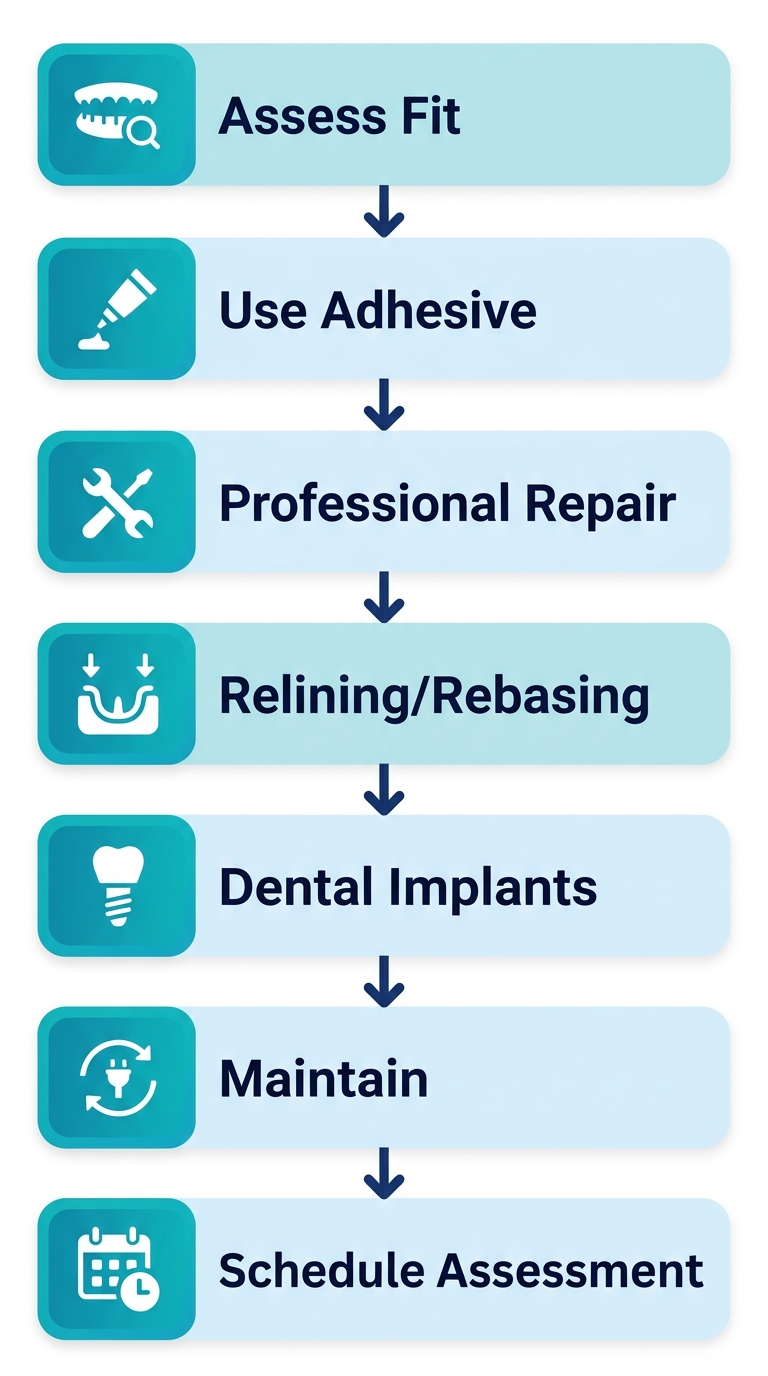
Step 1: Assess Your Denture Fit
A well fitting denture will be held securely in place all day long. It won’t slip off, rock around, or cause discomfort to your gums. Bite down lightly with your back teeth. Your denture should not move up and down, side to side, or wobble about when this happens.
There can be signs that there’s something wrong including clicking noises in your mouth, sore or swollen gum tissue, or it may feel loose if you yawn or try chewing food. Also check inside your dentures for sharp edges or tiny cracks.
If you’ve been wearing your denture(s) since time immemorial, it’s quite possible that the size and shape of your jaw has changed somewhat in those intervening years.
If you want to try adhesives or an at-home reline kit before doing anything else, visit your dentist first. Trying to get it fixed without professional help can cause more problems or make things even more uncomfortable. If it’s loose, adhesive can provide temporary stability, but a proper fit assessment is the first step.
Step 2: Use Denture Adhesive Safely
Putting denture adhesive in can hold a loose denture in position temporarily until you get around to going to the dentist for professional treatment. We suggest that you begin with a clean, dry set of dentures before applying the adhesive as this will allow the product to stick better.
If you’re using small, pea-sized dots or thin strips of adhesive on your fitting surface instead, apply them sparingly as they may ooze out and cause gagging if applied in too large amounts. Press the denture into position for several seconds before wiping off any excess.
It’s not recommended that you try to repair your dentures if they don’t fit properly with adhesive. If your dentures feel loose and/or have any sharp edges, see your dentist as soon as possible. Remove your denture each night, cleaning both the appliance and your gums thoroughly, and allow your mouth to rest.
If you experience irritation or suspect an allergy to an ingredient, discontinue use and check the label.
If you have looseness that cannot be resolved using adhesive, our team at The Grove Dentistry in Port Coquitlam can evaluate whether a repair or reline is the best path forward.
Step 3: Seek Professional Denture Repair
Denture adhesive provides a temporary hold, but if your denture still feels loose or shows cracks, professional denture repair is the safest next step. When you come to our Port Coquitlam clinic, we carefully assess the damage—whether it’s a broken tooth, a crack in the base, or a loose fit. Depending on the issue, we either repair your denture on-site or send it to our lab for meticulous restoration. Professional repair not only restores chewing function but also prevents gum sores, bite misalignment, and jaw discomfort caused by an ill-fitting appliance. After the repair, we check your bite and comfort to make sure everything feels just right. Having your denture repaired by a dentist gives you peace of mind that the work is done safely and precisely. For your convenience, we offer evening appointments for busy families. Sometimes repair alone isn’t enough, and the fit may need further adjustment, which we will explore next.
Step 4: Explore Relining and Rebasing Options
If denture wearers’ false teeth feel looser than usual following repairs at the dental office, they might be able to get them adjusted using in-office relining. This procedure involves adding a new layer of material—either soft or hard—to the inner surface of the denture. The addition gives them more cushion, helping fill in any gaps caused by changes to their gums and jaw bones that have occurred over time. As a result, their dentures should stay on better without requiring a complete replacement.
Sometimes, when just the base of the denture has worn out or broken down, but most everything else remains intact, rebasing offers another way to extend the appliance’s life. With this procedure, the entire existing foundation is stripped off, all the old material is removed, and it is replaced with a new base made of acrylic to better match the oral tissues.
A short visit with a dentist is the best way to identify the cause of looseness. Our team uses the latest digital dental technology to map your oral tissues and guide you toward the most appropriate adjustment—or, if these adjustments aren’t enough, a more permanent option like dental implants.
Step 5: Consider Dental Implants as a Permanent Solution
Although relining and rebase will improve how well your teeth fit for a while, those adjustments wear down over time. When a dental implant is installed in place, it supports the base of the removable denture. Small titanium posts are placed surgically into the jaw, where they fuse with the bone and act as artificial tooth roots. Unlike other means which merely adjust the base plate, the dentures rest firmly on the implant and slip less. Furthermore, this restores confidence when eating by preventing your new dentures from slipping out. Finally, implant-supported dentures can help preserve your jawbone over time because the implant keeps stimulating the facial bones. This is a benefit beyond what relining can offer.
At our clinic, our team invites you to see if implants suit your needs. We offer extended evening hours on Wednesdays to accommodate busy patients who wish to speak about their options. We provide a complimentary initial consultation which gives honest advice without any pressure. Whatever route you go down, taking good care of your dentures every single day will help maintain your smile both healthy and comfortable.
Step 6: Maintain Your Dentures for Lasting Comfort
Simple daily care is essential for keeping your dentures comfortable and secure. These include:
- Clean your dentures every day with a soft-bristled brush and a non-abrasive denture cleaner to avoid scratches that can trap bacteria.
- Handle them over a folded towel or a sink filled with water to cushion any accidental drops and prevent breakage.
- Soak dentures overnight in a denture-cleaning solution or plain water to maintain their shape; never use hot water, which can warp the material.
- Visit us for regular check-ups so we can adjust or reline your dentures for an optimal fit and to prevent sore spots.
Following these will help minimize irritation and keep your dentures in good condition. While routine care may help with some issues at home, a professional assessment at our clinic can address subtle fit issues before they turn into discomfort. Let us try to make sure that your smile remains both comfortable as well as confident!
Step 7: Schedule Your Assessment at The Grove Dentistry
Even with proper care, your dentures may still need a professional check-up to stay comfortable. To schedule your free, no-obligation denture assessment at our Port Coquitlam clinic, call (604) 941-2211 or drop by in person at 1160-2961 Cambridge Street. Our office is open Monday, Tuesday and Thursday from 8:00 am to 4:30 pm, and Wednesdays from 8:00 am to 7:00 pm—perfect if you need an evening appointment. We are closed Friday through Sunday. Your first assessment is free and there is no obligation to proceed; we simply want you to understand your options without any pressure or financial risk. Our friendly team welcomes patients from Port Coquitlam, Coquitlam, Port Moody, Pitt Meadows and across the Tri-Cities area. We take the time to listen to your concerns. If your dentures still feel loose after your assessment, we can walk you through common fit issues and practical solutions in the next section.
Troubleshooting Common Denture Fit Issues
Even after a careful initial fitting, some patients encounter fit issues as their mouth adjusts to new dentures. It’s common for dentures to feel slightly loose or for sore spots to appear during the first few weeks, especially while you adapt to eating and speaking with a new prosthetic.
The change can be caused naturally due to many reasons like jaw shrinking over a period of years, bone resorption that alters the foundation supporting your denture and gum tissue shifting with age and health, along with loss of denture material resulting from wear and tear of regular use. You might notice that a tooth on a partial denture begins to feel wobbly; if you’re wondering how to fix a loose tooth on dentures, it’s important to understand that this typically signals a need for professional attention. Well, this should only prompt a visit to your dentist who will then determine the appropriate way to resolve the problem.
To give some short-term respite, try using a denture adhesive, which can provide a helpful hold throughout the day. Knowing how to fix ill-fitting dentures safely ultimately means visiting your dentist for an adjustment. Only a trained professional can modify the denture base without risking damage to the appliance or your oral tissues.
First time denture users need some time to adapt to their new set of teeth. It’s normal that they have small sore spots. These should heal in due time, as soon as your dentist has adjusted them properly. Do not attempt to reshape or reline your dentures at home; doing so can lead to costly repairs or injury. If looseness persists, interferes with eating, or causes ongoing discomfort, we recommend contacting our team for a thorough evaluation. The above suggestions will help you get back on track to enjoy having a mouth full of healthy smiles.
Common Questions about Fixing Loose Dentures
Why do my dentures feel loose even if they fit well before?
Loose dentures often result from jawbone shrinkage, gum tissue changes, or thinning of the denture base over time. Even if they once fit well, natural bone resorption alters the support, causing movement during eating or speaking. Signs include rocking, clicking, or sore gums. A professional exam pinpoints the exact cause.
Can a dentist fix loose dentures without making a whole new set?
Yes, a dentist can often fix loose dentures without a new set. Professional relining adds a cushioning layer to the inner surface to fill gaps from gum and bone changes. Rebasing replaces only the worn base while keeping the teeth. These adjustments restore a secure, comfortable fit and extend the appliance’s life.
Is it safe to use denture adhesive to fix loose dentures at home?
Denture adhesive can be used safely as a temporary hold until you see a dentist. Apply pea-sized dots to a clean, dry denture and press firmly. However, adhesive does not correct an ill-fitting appliance; persistent looseness requires a professional assessment to prevent gum sores, infection, or accelerated bone loss.
What are the professional options for repairing loose dentures such as relining or rebasing?
Professional options include relining and rebasing. Relining adds a soft or hard layer to the inner surface, filling gaps from jaw and gum changes. Rebasing replaces the worn base while keeping the existing teeth. A dentist may also repair cracks or broken teeth. These procedures adjust fit without a full replacement, extending denture life.
When should I consider dental implants as a permanent solution for loose dentures?
Consider dental implants when relining and rebasing no longer provide lasting stability or if significant jawbone loss makes a denture perpetually loose. Implant-supported dentures use titanium posts for a secure, slip-resistant fit and help preserve jawbone through stimulation. The Grove Dentistry offers a free initial assessment to evaluate candidacy.
Your Path to a Secure, Comfortable Smile
If you’re looking for how to fix loose dentures, a professional evaluation is the essential first step toward lasting comfort. Common solutions like relining, adjustments, and implant-supported dentures can turn a loose fit into a secure, stable smile. However, only a thorough exam can pinpoint the cause of looseness.
Our brand new clinic in Port Coquitlam offers a relaxed, modern atmosphere and a free, no-obligation consultative visit on Wednesday evenings if this works for you.
Contact our friendly staff at (604) 941-2211 or stop by in person located at 1160-2961 Cambridge St to book your appointment right now. We must remind you that since each smile is different from another, there may be variations in terms of treatment outcomes, which cannot be predicted accurately. Always consult a dental professional for diagnosis or treatment advice.
Book Your Free Denture Assessment
You’ve now explored a range of practical solutions for loose dentures, from using adhesive safely to understanding permanent implant options. The next logical step is a professional evaluation to determine what’s causing the looseness and which fix suits you best. At our clinic, we offer free initial assessments with no obligation, so you can get expert advice without any pressure. Our friendly team can check your denture fit, discuss relining or rebasing if needed, and even walk you through the possibility of dental implants for a long-term solution. With evening hours available on Wednesdays, it’s easy to fit a visit into your schedule. Call us at (604) 941-2211 or visit our practice page to book your appointment and take the first step toward a secure, comfortable smile.


